

Mechanical Breaking vs. Rock Blasting: Cost, Time & Feasibility

The Commercial Site Excavator’s Dilemma

When hard rock is encountered during site preparation, utility trenching, or foundation digging, general contractors face a critical decision: Should you break the rock mechanically using excavator-mounted hydraulic hammers (hoe-ramming), or bring in a specialized drilling and blasting team?

While hoe-ramming is often perceived as the simpler option because the equipment may already be on-site, using mechanical force on dense, unfractured rock can quickly lead to budget overruns, severe equipment wear, and major schedule delays.

Understanding the key operational thresholds between mechanical breaking and controlled blasting is essential for keeping commercial earthwork projects on time and within budget.
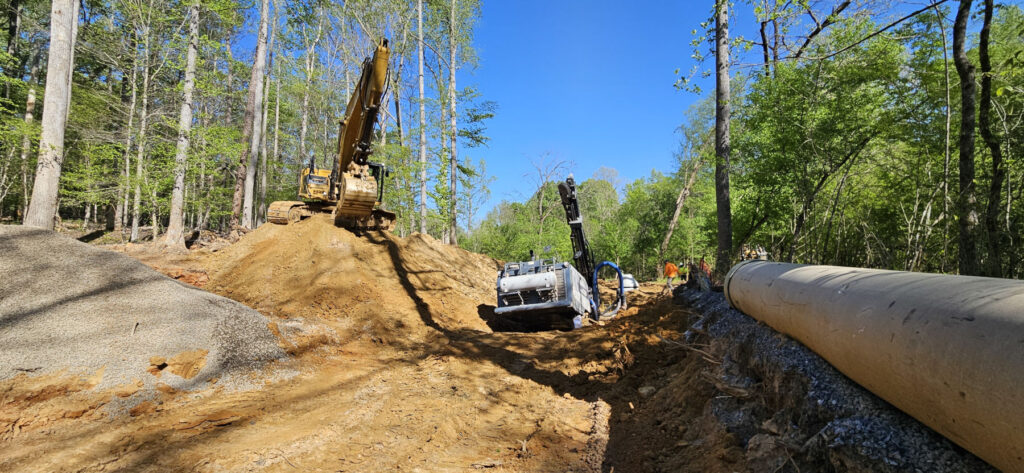
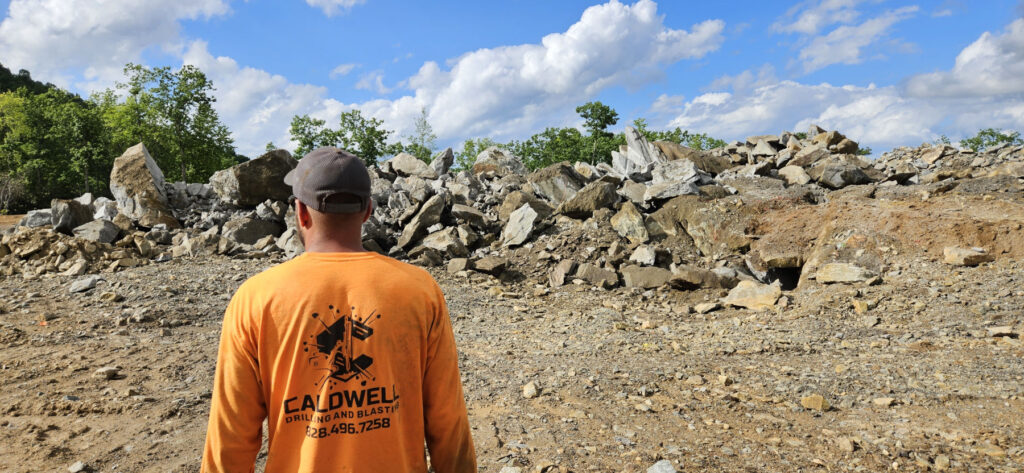
Key Comparison Metrics

Factor Mechanical Breaking (Hoe-Ramming) Controlled Drilling & Blasting
Best Used For Small rock volumes (<300 cu yds), shallow utility trims, soft/weathered rock. Mass rock excavation (>300 cu yds), deep trenches, high-compressive-strength rock.
Production Speed Slow; incremental surface chipping (10–50 cu yds per day depending on rock hardness). Rapid; fractures hundreds or thousands of cubic yards in a single micro-second shot sequence.
Equipment Wear & Fuel High hydraulic stress, continuous fuel consumption, rapid point wear, and machine fatigue. Targeted drill rig operation with minimal wear on secondary excavation equipment.
Vibration Profile Sustained low-frequency vibration over days or weeks. Short, micro-second burst monitored precisely by seismographs.
Cost Scale Cost increases linearly per hour/day; highly expensive for large yardage. Higher setup efficiency; cost per cubic yard drops dramatically as volume increases.

The 3 Decision Factors: When to Switch to Blasting

Volume & Depth

As a general rule of thumb, if your site contains more than 300 to 500 cubic yards of mass rock, hoe-ramming rapidly loses its cost advantage.

  • Hoe-Ramming: Works mechanically from the top down. As the trench or pit gets deeper, the impact energy dissipates, significantly slowing production rates.
  • Blasting: Drills directly to the required subgrade depth. A single engineered blast sequence shatters the entire rock column down to pay-grade in seconds, allowing standard excavators to muck out the loose material effortlessly.

Rock Compressive Strength & Geology

Not all rock is created equal. Soft sandstones or heavily fractured shales yield easily to hydraulic hammers. However, dense igneous or metamorphic rock—such as granite, unweathered limestone, or blue quartz with compressive strengths exceeding 10,000 PSI—will resist hoe-rams. Trying to hammer unyielding rock consumes thousands of gallons of fuel and risks blowing hydraulic lines for minimal daily progress.

Continuous vs. Instantaneous Vibration

A common misconception is that hoe-ramming is always safer near existing structures. While blasting sounds more intense, hoe-ramming subjects nearby structures to continuous, low-frequency vibrations for days or weeks on end, which can cause fatigue in adjacent concrete and utilities.

Controlled blasting near utilities and structures is often a better choice because it uses electronic delay detonators to divide the blast into millisecond intervals. Combined with heavy blasting mats, peak particle velocity (PPV) is strictly contained below regulatory thresholds, providing a safer, single-instant solution.

The Hybrid Solution: Blasting for Production, Ramming for Trim

On complex commercial sites, the most cost-effective strategy isn’t always choosing one method over the other—it’s combining them.

  • Mass Blasting: Drilling and blasting the core rock body to quickly bulk-excavate 90%+ of the material to subgrade depth.
  • Mechanical Trim: Utilizing a smaller hoe-ram strictly to clean up final trench corners, footing edges, or high spots where precision micro-trimming is required.

Unsure Which Method Your Job Site Needs?

Send our engineering team your geotechnical reports, boring logs, or site cross-sections for a rapid, complimentary field assessment and transparent cost comparison.

Related Articles and Engineering Guides

Explore additional technical resources from our Drilling & Blasting 101 Knowledge Center, designed to help project managers, civil contractors, and estimators navigate complex rock excavation.