

How Close Can You Blast to Existing Utilities & Structures?

The Myth of the Safety Radius

One of the most frequent concerns from project developers and site engineers is proximity: “Can we blast this rock if we are 15 feet from an active gas line, a highway, or an occupied building?”

The short answer is yes. Modern controlled blasting is not an all-or-nothing explosion; it is a highly controlled physical reaction governed by precise physics, seismographic monitoring, and regulatory standards (such as USBM RI 8507 and OSMRE limits).

Rather than relying on arbitrary “distance radiuses,” safety is determined by controlling energy output per delay, managing frequency (Hz), and restricting Peak Particle Velocity (PPV).
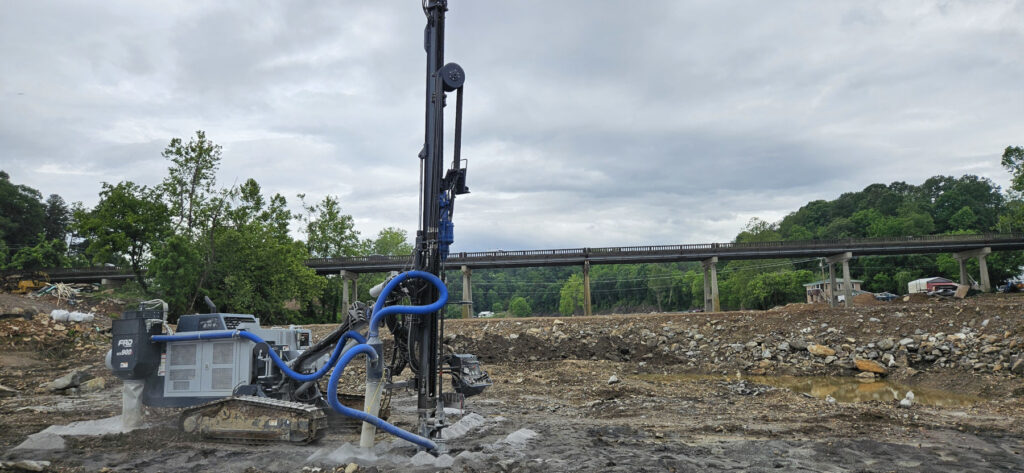
Key Proximity & Vibration Metrics

Metric / Control What It Measures Standard Threshold / Engineering Practice
Peak Particle Velocity (PPV) Speed at which ground particles vibrate (inches per second). Typically kept under 0.5 to 2.0 in/sec depending on structure type and frequency.
Scaled Distance (Ds) Formula balancing charge weight per delay against distance. Used to determine maximum allowable explosives per 8-millisecond delay window.
Blast Mat Coverage Physical barrier composed of woven steel cable or heavy rubber tires. Prevents flyrock completely, containing energy below ground level.
Pre-Blast Surveys Documentation of existing conditions within a specified radius (e.g., 250–500 ft). Establishes baseline structural integrity before any drilling or blasting begins.

3 Engineering Controls for High-Proximity Blasting

1. Electronic Delays (Micro-Sequencing)

Instead of detonating all explosives simultaneously, modern blasts use electronic detonators accurate to within a fraction of a millisecond.

  • How it works: A shot with 50 total pounds of explosive might be divided into 20 separate 2.5-pound charges firing milliseconds apart.
  • The result: The rock fractures efficiently, but adjacent structures only feel the vibration of a single 2.5-pound charge, effectively neutralizing ground shockwaves.

2. Seismographic Waveform Analysis

Every critical shot near utilities or structures is monitored using multi-directional seismographs placed at the closest structure foundation.

  • Seismographs measure three axes of movement: Transverse, Vertical, and Longitudinal.
  • Real-time monitoring allows blasting engineers to evaluate ground frequency (Hz) continuously and adjust subsequent hole patterns long before vibration thresholds are approached.

3. Trench Relief & Presplitting

When working right up against a property line, concrete slab, or utility easement, blasting contractors utilize presplit drilling or relief slot trenching.

  • A line of closely spaced, uncharged or lightly charged holes is drilled along the buffer line prior to mass blasting.
  • This creates a clean fracture plane (a physical gap in the rock) that stops seismic shockwaves from traveling past the property line.

Blasting Near Specific Utilities

  • Gas & Petroleum Pipelines: Steel and ductile iron pipes are remarkably resilient to high-frequency ground vibrations. Blasting frequently occurs within 10 to 15 feet of active mains under strict pipeline company oversight and lower PPV restrictions (often 1.0 in/sec or lower).
  • Fiber Optic & Electrical Conduits: Buried lines in concrete encasements require low-impact micro-delays to prevent ground displacement around duct banks.
  • Fresh Concrete / Early-Age Structures: Blasting near newly poured concrete footings is carefully staged based on compressive strength cure times (usually waiting until concrete hits a minimum threshold, such as 500–1,000 PSI, before resuming nearby low-PPV shots).

Planning a Site Prep Project Near Sensitive Structures?

Connect with our engineering team to discuss pre-blast surveys, vibration modeling, and site-specific blast designs for your project.

Related Articles and Engineering Guides

Explore additional technical resources from our Drilling & Blasting 101 Knowledge Center, designed to help project managers, civil contractors, and estimators navigate complex rock excavation.